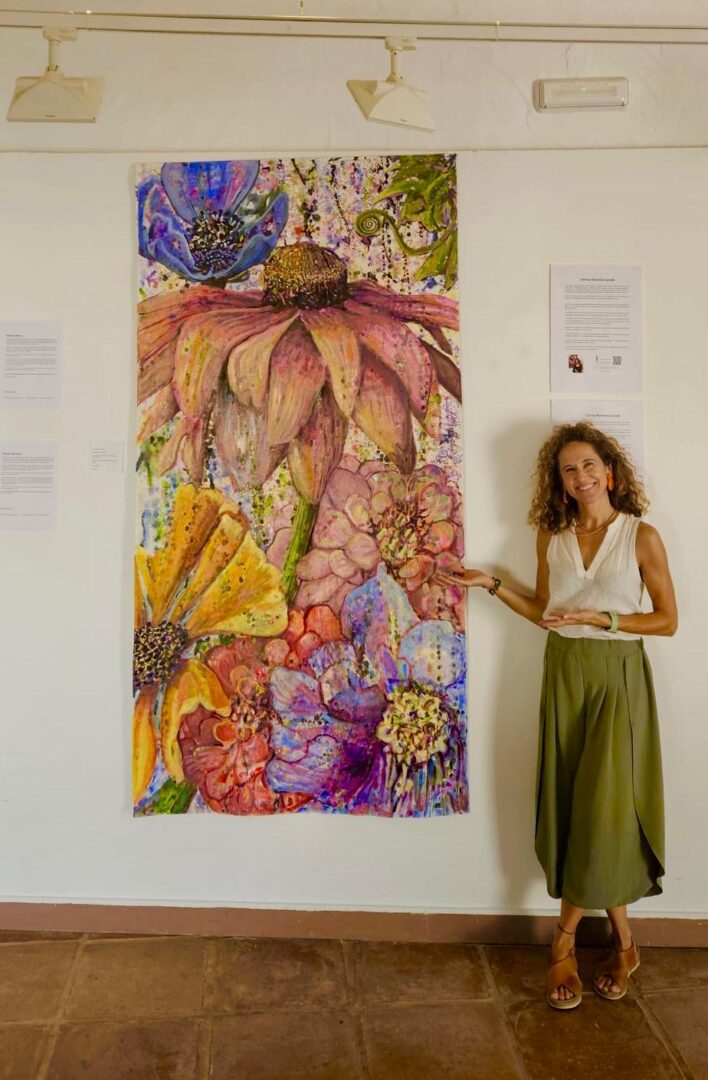
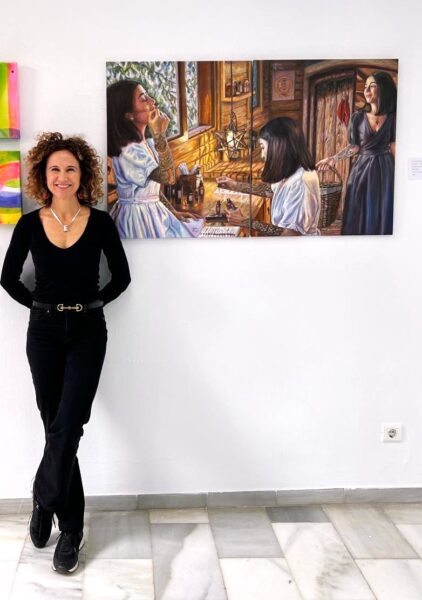

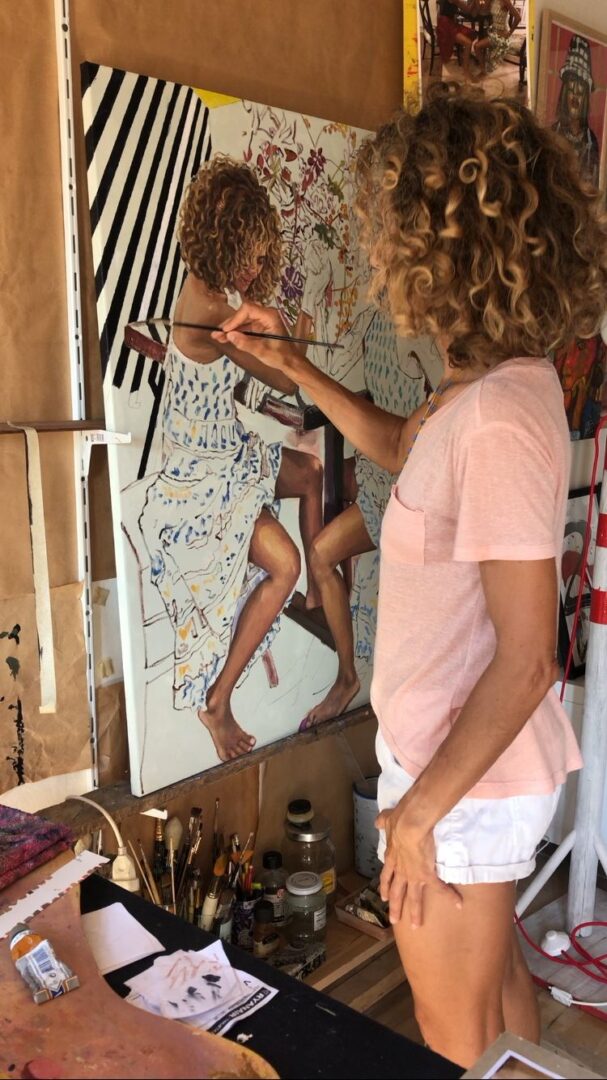
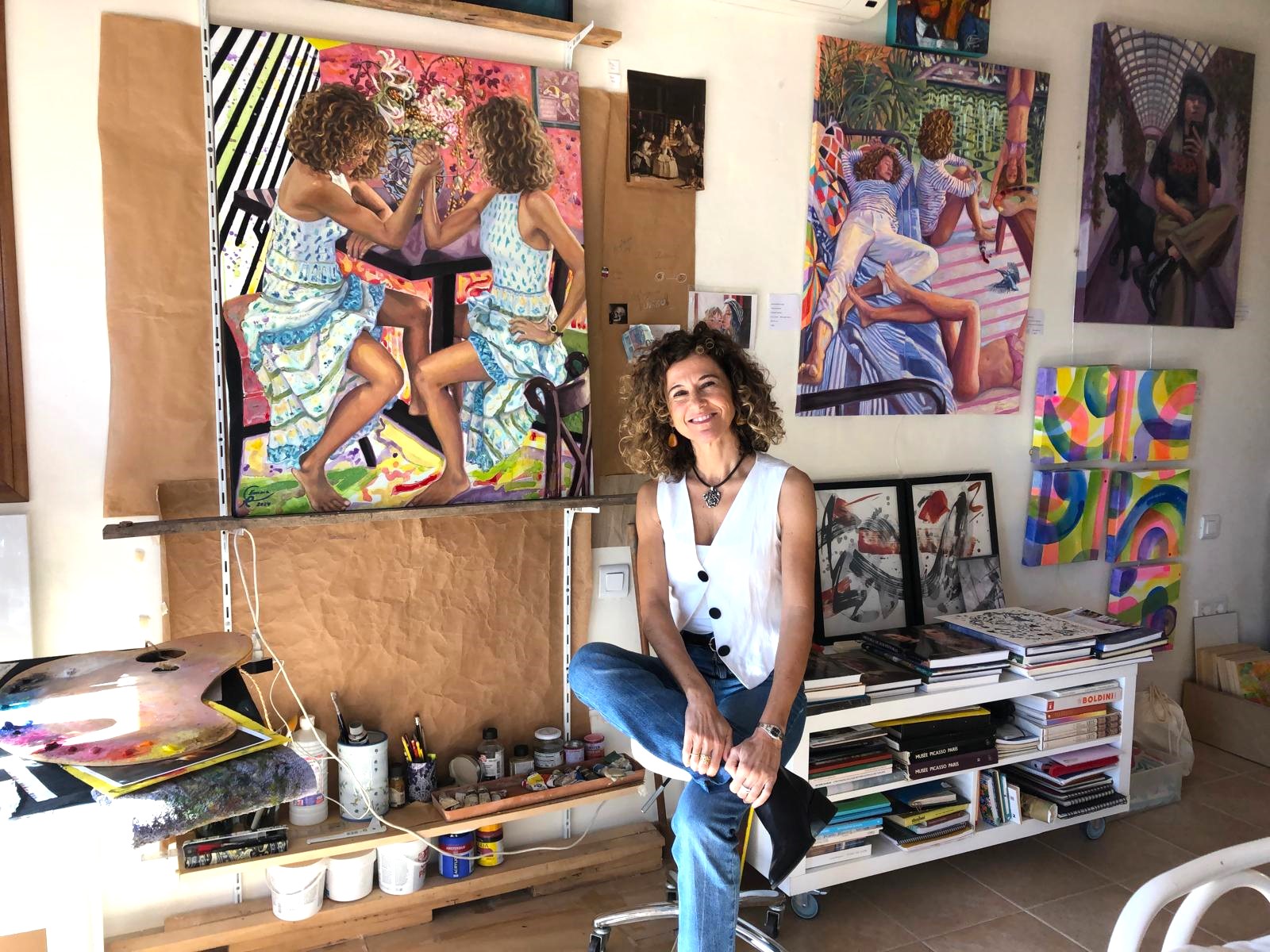
Emma Ramírez Conde (Burgos) is an artist of profound transitions and vital courage. An economist by training, after years of a career in the demanding world of finance and consulting in Madrid, she decided to make a radical turn in search of a truth that numbers could not explain. Her compass led her to Southeast Asia, where the silence of Bali and the artistic effervescence of Chiang Mai (Thailand) acted as the fuel to ignite her true vocation.
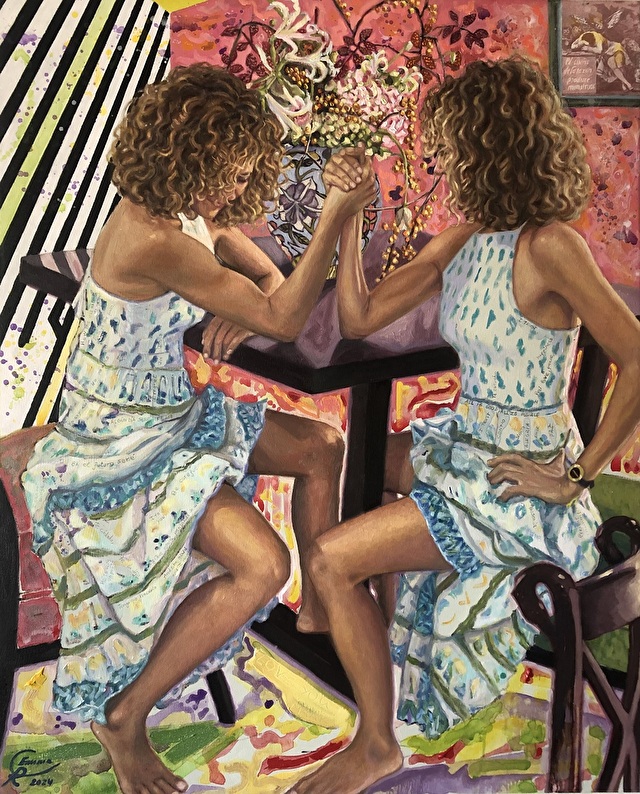
Finalist of the tARTget Prize 2025 with her work When I had the answers, the questions changed, and selected for the tARTget La Mancha itinerant exhibition, Emma returns in the 2026 edition with a consolidated voice. Her painting, which navigates between figuration and abstraction, is not merely aesthetic; it is an exercise in introspection, a necessary pause in a world that runs too fast, and a bridge built toward the viewer to find that which unites us beyond the conscious mind.
Emma, you spent years between financial balance sheets and consulting in Madrid, and traveling through Europe, before taking a leap into the void toward art. What was that moment like when the numbers froze and you felt that the brush was your tool of salvation?
In that era, I was already changing a lot on the inside, and this was also reflected in what was about to happen on the outside. I didn’t know exactly what I was going to do, but I had the clarity that I had to take the leap and, surprisingly, the day I made the decision, I felt an enormous confidence that everything would go well, because I was following my intuition, my heart.
From Burgos to Madrid, and from there to an initiatory journey through Southeast Asia. They say that in Bali one does not find what one seeks, but what one needs. What did you discover in those painting classes on the island that made you say: “this is what I have longed for all my life”?
I have traveled quite a bit for work and for pleasure, but I had never been to Asia, and suddenly it appeared on the radar. I believe life took me there because certain things had to happen, and so they did. I spent several months painting in the studio of a local artist who opened my eyes to the possibility of studying Fine Arts there. When he told me, my heart skipped a beat and I knew that this had been my great dream without me being fully conscious of it. Doing it in Southeast Asia seemed most stimulating to me. I am enormously grateful to him for this discovery.
You lived for four years in the artistic community of Chiang Mai, in northern Thailand. How did that immersion in a culture so distinct from the Castilian one influence your color palette and your way of understanding composition?
Well, the artist was “officially” born there and spent her first years there, so yes, I think there is a lot of influence. The exuberance of the colors of Asian nature and its traditions have a profound impact on my subject matter and also on my color. I had some teachers, exceptional artists, who have left a deep mark on me through their knowledge and their art. All of that goes with me. When I returned to Spain, I created the series Asian Masters, twelve portraits that pay homage to those people who exerted such an important influence on my life at that moment.
In Spain, I have had two other wonderful masters who have polished my technique and have been a very important reference in my growth as an artist (Hangel Montero and Alejandro Carpintero).
Your finalist work in the tARTget Prize 2025 has a fascinating title: When I had the answers, the questions changed. A lot of philosophical weight. Was it painting that changed the questions for you, or was it the change of life that forced you to seek new answers on the canvas?
Interesting question (laughs). It was life; life is the engine of everything, including painting.
You have mentioned that for you, painting is a path of “pause and listening.” In a society that suffers from an attention deficit, how do you manage to get the viewer to stop in front of your painting and enter that state of introspection with you?
I do not do it intentionally; I search in silence and in listening, and that is where I extract my “gold,” my inspiration. That which is within me will resonate with some people, and that is where we feel, share, and connect. They are very special moments that fill both parties with emotion; we all enjoy it.
You move with ease in both figuration and abstraction. What does the detail of a face give you that the freedom of an abstract stain does not, and vice versa?
Faces and portraits have caught my attention all my life. There is something magical and enigmatic in them, and being able to portray them is a luxury for me. Painting a portrait gives me a destination that motivates me and a process that is always a challenge and, at the same time, something very beautiful to realize.
On the other hand, abstraction gives me freedom, verve, movement; I embrace the unknown. It gives me the “having no destination,” which I find very motivating. When I open myself to the process… anything can happen.
You were selected for the tARTget La Mancha exhibition and now you return for the 2026 edition. How has the Emma who arrived at the contest for the first time evolved compared to the artist presenting herself this year? What do you seek to explore in this new call?
A year has passed and there have been some changes. More than changes, I would say evolution.
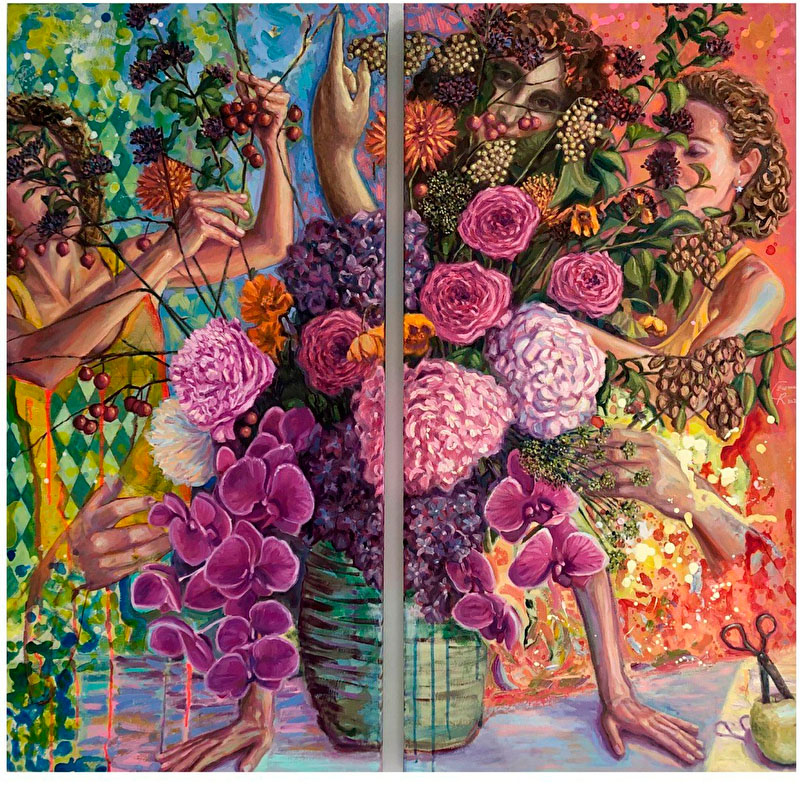
My most recent series, Retratos a flor de piel (Portraits on the Surface), began wanting to be pure abstraction and ended up being an abstraction that supports and embraces figuration. I was very open to whatever would come, and nature arrived making a strong entrance (laughs). Intuition led me down that path.
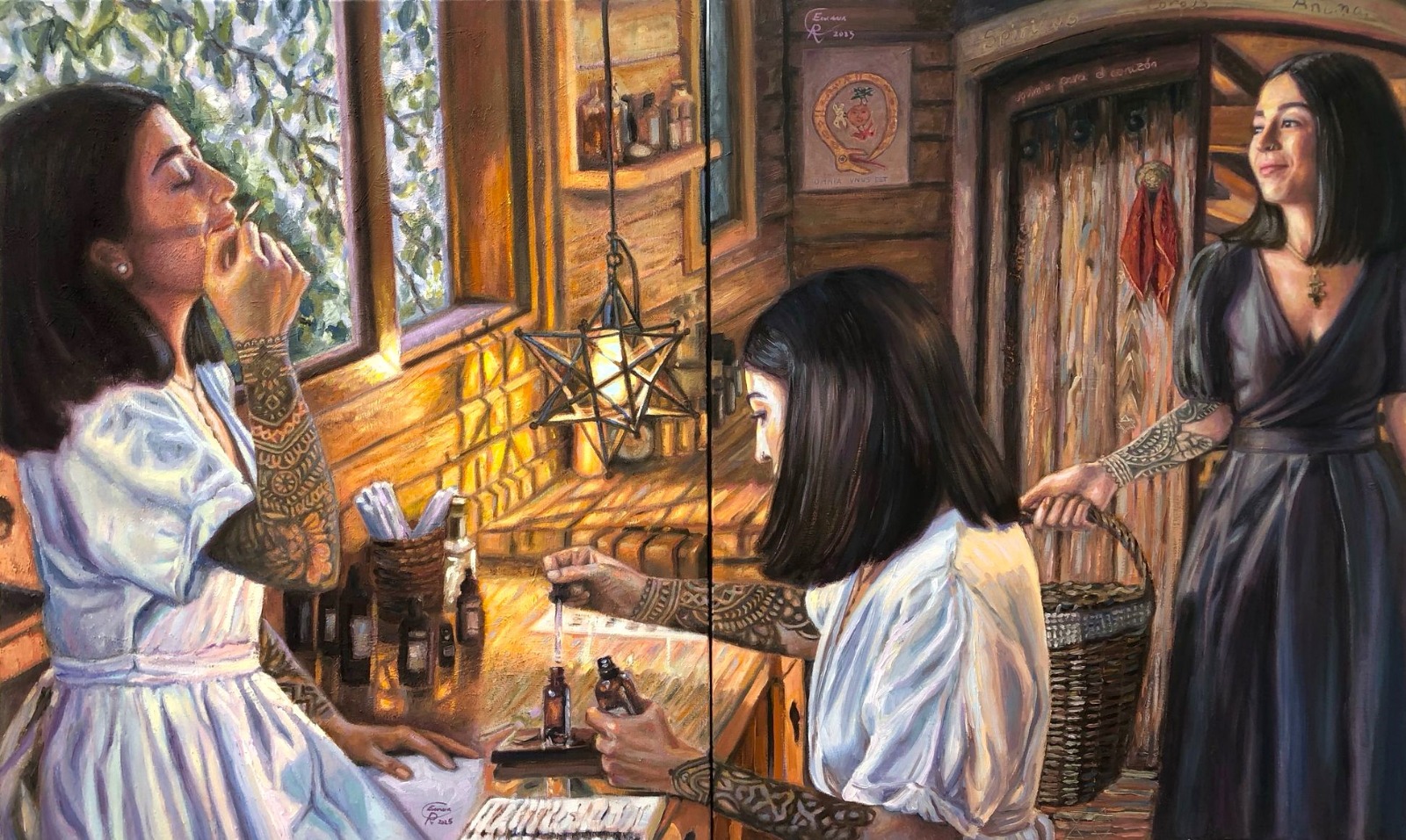
For the tARTget Prize 2026, I am participating with two works. One from the series I just mentioned, a powerful and colorful fusion. The other is titled The Alchemist; it is a realistic figurative painting inspired by an Iranian perfumer artist who is a friend of mine. I hope both are liked very much!
You say you are interested in inspiring stories and traditions that help us “live better.” If you had to choose a tradition or an experience from your travels that has remained tattooed on your pictorial style, what would it be?
I think I would stay with a wonderful piece of advice given to me by a Thai artist recognized at an international level. I had just finished art school and didn’t know very well where to advance—style, subject matter. Then he told me: “Emma, whatever you do, let it be good for you. You are going to employ a lot of time and effort; let it be beneficial to you, beyond fashions or trends.” It is something I keep in mind when deciding my next steps.
Art is, according to your words, a vehicle of connection. Has it ever happened to you that a collector from a distant country—you have works from Germany to Sweden—confessed to feeling exactly the same thing you felt when painting the picture?
Yes, you never know if it is exactly the same, but those people have connected with the work in a deep, magical way. Even beyond what I could expect. All of them have stood in front of the work and then approached me to know more about it. I have seen many emotional eyes and that is an enormous satisfaction.
If tomorrow you could open a studio in any corner of the world to paint your next series, but you could only take one color and one memory, what would they be?
Fluorescent pink and the joy of painting with ease.
Emma, to finish this chat: if you had to summarize in three brushstrokes what it means to you to be part of the tARTget Prize family of artists, what would they be?
My experience participating in the tARTget Prize has been truly super positive. You were always very kind, professional, and effective in all communications.
Regarding your magazine, I love it; it has truly interesting content.
And of course, the awards gala at the Ateneo de Madrid was a wonder; the place so emblematic, the presentation of the event enjoyable and stimulating, sharing with wonderful artists from all over the world… an authentic pleasure. I am very grateful to you and happy to be part of this artistic family. All this has made me want to repeat this year. I thank you for this interview and wish you the best for tARTget Prize 2026.